Service area: West Roxbury, MA
Mold removal and remediation for homes across West Roxbury — and what tends to cause moisture problems in this part of the city.
West Roxbury housing & moisture patterns
West Roxbury sits in the southwest corner of Boston, bordered by Roslindale and Jamaica Plain to the northeast, Chestnut Hill and Brookline to the north, Newton to the northwest, Dedham and Needham to the southwest, and Hyde Park to the southeast. It was annexed by Boston in 1874, and much of the residential building that followed predates modern foundation waterproofing.
The practical consequence is that a lot of housing here is older than the construction methods most people assume. Homes built before poured-concrete foundations became standard often sit on stone or rubble foundations, which are more porous than concrete and can let moisture pass through the wall rather than stopping it. That does not make a damp basement inevitable — plenty of older homes stay dry — but it does change what an assessment should be looking for.
The neighbourhood is mostly single-family homes with some two-families. Age, foundation type, whether a basement has been finished, and how the ground around the house drains all affect how moisture behaves, and they vary street to street rather than neighbourhood-wide.

Where the water actually comes from
The City of Boston describes three kinds of flooding affecting the city: coastal flooding along the shoreline, riverine flooding along the Charles, Neponset, Mystic and Muddy Rivers, and stormwater flooding when heavy rainfall overwhelms the drainage system maintained by the Boston Water and Sewer Commission.
West Roxbury is inland, so coastal flooding is not the relevant category here. The two that matter locally are riverine and stormwater. The Charles River forms part of the neighbourhood's western edge — the stretch along VFW Parkway toward the Dedham line runs close to it — and the City lists minor-to-moderate flooding along the Charles among the riverine risks it tracks.
Stormwater is the one most homeowners actually meet. When rain arrives faster than the drainage system can carry it away, water backs up at street level and collects against foundations. That is a city-wide characteristic rather than something specific to West Roxbury, but it is the mechanism behind most wet basements after a heavy storm.
How to check your own property
Flood risk is specific to a parcel, not to a neighbourhood, and we are not in a position to tell you what your property's designation is. The City of Boston publishes a flood map tool that shows property-level risk, and FEMA flood zone designations — zones beginning with A or V indicate the highest mapped risk — are the authoritative reference. Both are worth checking before assuming anything either way about your own address.
This matters for mold because the two questions are linked but not identical. A property can sit outside any mapped flood zone and still have a persistently damp basement, and a property inside one can stay dry for years. What matters for mold is whether water is reaching materials and staying there.
Why moisture comes back after it is cleaned up
Water in the ground exerts pressure against anything below grade. After heavy rain or a spring thaw, saturated soil pushes against foundation walls and floor slabs, and that pressure finds whatever path is available — a hairline crack, a porous section of stone, the joint where the wall meets the floor. This is why a basement can be dry for months and then damp for a fortnight without anything about the house having changed.
It is also why removing visible growth on its own tends not to hold. Mold needs sustained moisture; take away the growth but leave the water path, and conditions return to what they were. That is why identifying the water source is part of a proper removal job, not an afterthought — the fix for seasonal seepage is usually outside the house, in grading, gutters or drainage, not inside it.
Seasonal pattern
Two periods generate most of the calls. Spring, when snowmelt and rain saturate ground that is still partly frozen and cannot absorb it, so water moves sideways toward foundations instead of down. And humid summer weather, when warm outside air meets cool basement walls and condenses on them — no water entering the building at all, but the same damp result.
The two need different responses, which is why identifying which one you have matters more than the fact that the basement feels damp. Our plastic-sheet test distinguishes them in a day.
What prevention actually looks like
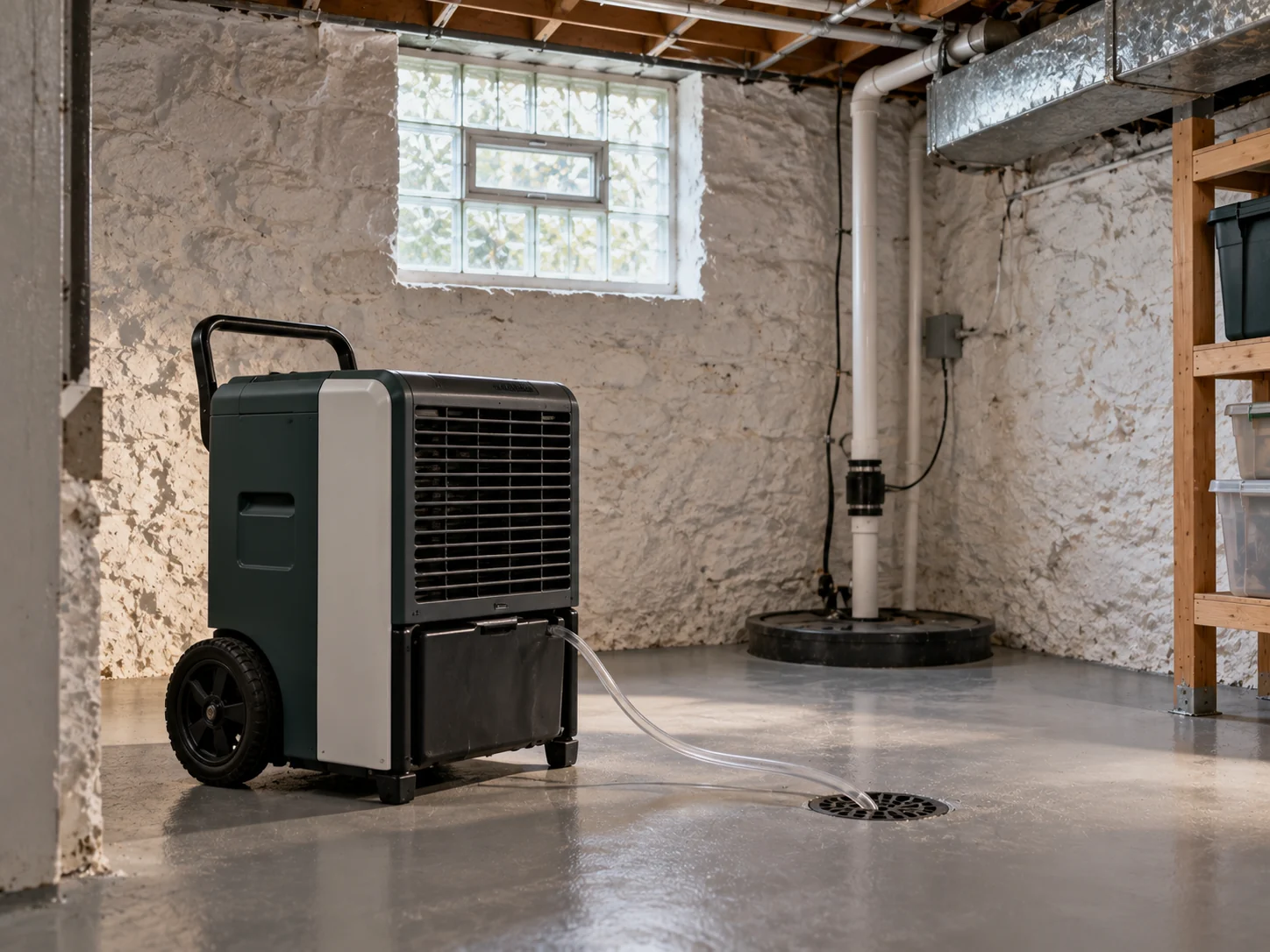
For homes with a history of recurring moisture, a properly sized dehumidifier with a drain line — not a bucket you empty manually — combined with a simple humidity monitor can flag conditions before they're bad enough to grow mold again. Published guidance puts the target below 60% relative humidity, ideally between 30% and 50%. It's a modest, ongoing step compared with repeat removal.
What this means for your home
If your house was built before the 1960s and has an unfinished or partially finished basement, the two things worth checking yourself before calling anyone: a musty smell that's stronger near the foundation walls, and any visible efflorescence (a white, chalky mineral residue) on stone or concrete, which usually means water has been moving through the wall at some point. Neither one automatically means you have a mold problem, but both are worth a free assessment rather than ignoring.
An assessment here starts from the building — foundation type, where water can reach it, how the ground drains, and which of the seasonal patterns above fits what you are seeing — rather than a generic checklist. If your home sits just outside West Roxbury, get in touch and you'll get a straight answer on whether we can help.
Not sure if your address fits the pattern?
Describe what you're seeing and you'll get a straight answer on whether it's the kind of thing worth a closer look — no obligation.