Attic Mold Removal
Dark staining across the roof deck usually means warm air is getting somewhere it shouldn't — not that the roof has failed.
Why it's almost never a leak
Most people who find dark staining on the underside of their roof sheathing assume the roof is leaking. It usually isn't. Attic growth is far more often a ventilation and air-sealing problem: warm, humid indoor air rises through gaps around light fixtures, attic hatches and plumbing stacks, hits the cold underside of the roof deck, and condenses there. Given enough repeated condensation through a New England winter, that's all it takes.
This matters because the fix is different. Replacing shingles does nothing for a ventilation problem — the full breakdown of the three usual causes covers how to tell them apart before deciding what needs doing.
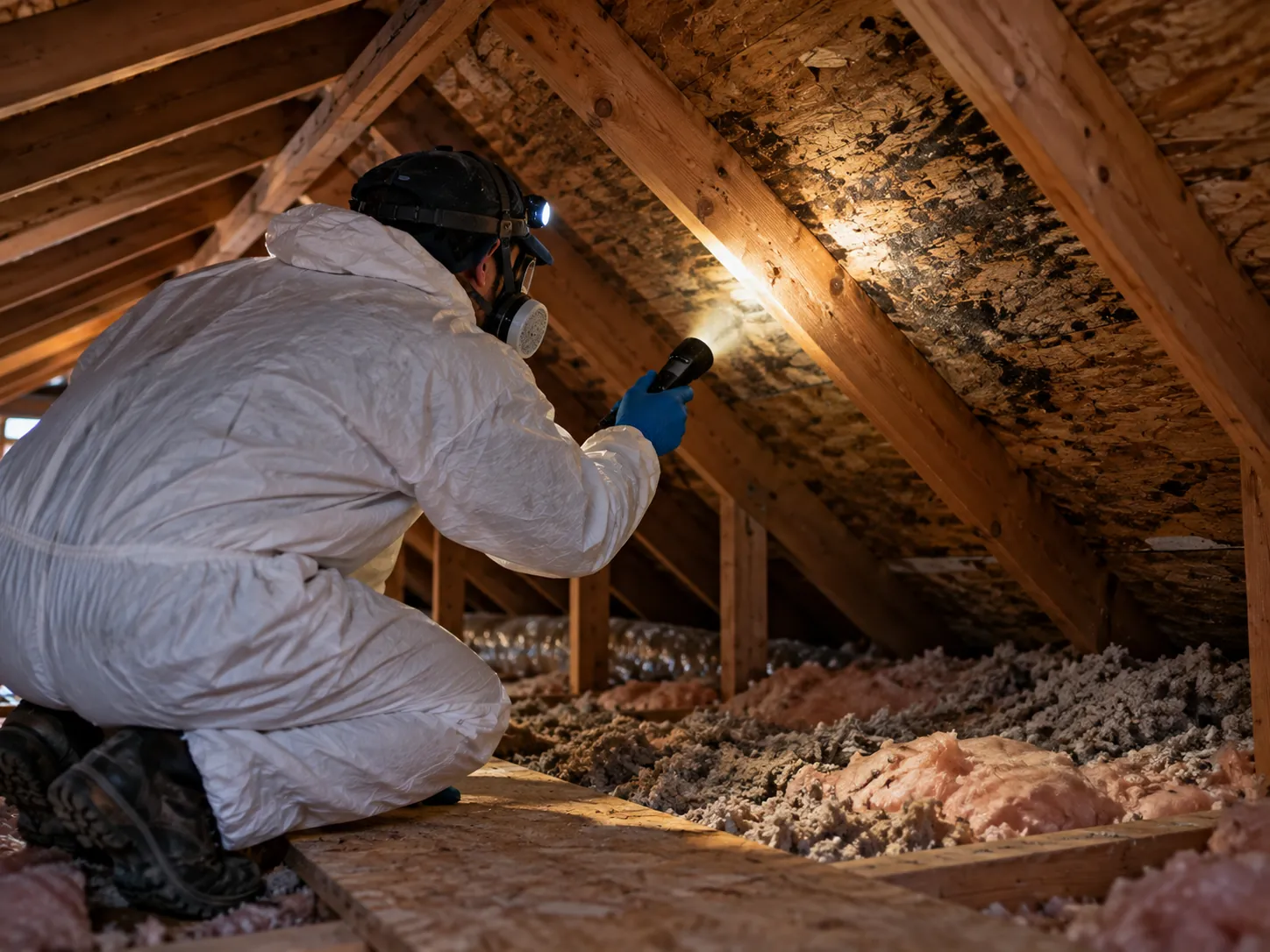
What's different about removal here
Same underlying removal process, applied to a space with its own particular constraints.
- Access and working space. Attics are rarely built for someone to move around comfortably, which affects how containment gets set up and how long the work takes compared with a room at floor level.
- The affected surface is usually the structure itself. Roof deck sheathing and rafters are the surfaces growth typically colonizes — not drywall or insulation, though compacted or damp insulation is itself a sign worth checking for.
- Fixing the cause has to happen too, or it comes back. Removing what's grown on the sheathing without correcting the ventilation or air-sealing that caused it is a near-guarantee of the same staining reappearing within a year or two.
- Ice dams point at the same root cause. If you've had ice dams along the eaves in winter, that's attic heat loss — worth mentioning during an assessment even if it seems unrelated to the mold itself.
What to expect
An assessment for attic mold starts by identifying which of the three usual causes is driving it, since that determines whether the fix holds. From there it's the same contain-remove-treat-verify process used anywhere else in the house — the mold removal page covers each step.
Questions about attic mold
If my roof isn't leaking, why would my attic have mold?
Ventilation, not the roof, is the usual cause. Warm, moist indoor air rises into the attic and finds somewhere cold to condense — the underside of the roof deck — and given enough time, that repeated condensation is enough to support growth on its own, with no leak anywhere in the picture.
Are ice dams actually connected to mold?
Indirectly, yes. Ice dams form when attic heat melts snow on the roof, which refreezes at the colder eave and can back water up under the shingles — but the heat loss that causes the ice dam in the first place is the same air leakage that drives attic condensation generally. Fixing one tends to help the other.
Do I need to replace my roof to fix this?
Almost never for the mold itself. The roof deck and shingles are rarely the problem — air-sealing where warm air is escaping into the attic, and making sure existing ventilation is actually working, usually addresses the cause. Removal deals with what's already grown; a roofer isn't normally part of that.
Free assessment for your attic
Describe what you're seeing — where in the attic, and whether you've noticed ice dams in winter — and you'll get a straight answer on what's actually causing it.